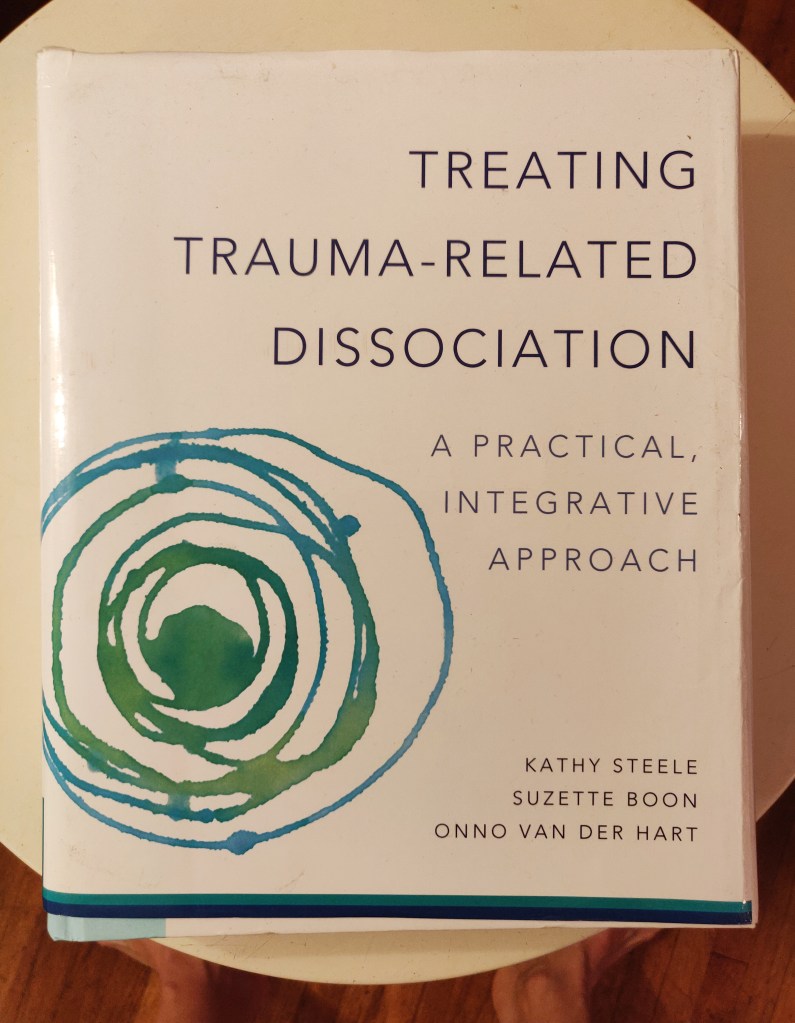
The cover is getting tattered and I’m STILL not fully through it, but READ THIS BOOK! I cannot emphasize enough how critical it is, particularly in trauma work, to be able to identify dissociation in our clients. We ALL dissociate to some degree – daydreams, spacing out, finding ourselves thinking one thing but instead saying the thing we KNOW will cause trouble. (Been there, done that.)
Dissociation, like many patterns, develops as a protective pattern but when it stems from more intense childhood neglect or emotional or physical abuse, it can begin to show up as “parts”. A person may have a part that functions well at work for instance, but then have other parts that start to interfere with and undermine a person’s good intentions and desired outcome in other areas of life. And, dissociation can really get in the way of therapeutic work, particularly trauma work, if the therapist and/or client don’t know it’s happening.
I’ve been reading some pretty dense books on dissociation as I’ve been going through trauma focused Brainspotting and EMDR trainings in the past year. (My most valuable training has been with Dolores Mosquera, who also has helpful books.) This ginormous book however, feels critical for self-education on dissociation. It’s taking me SO MUCH TIME to try get my head around the concepts but slowly I’m able to grasp the terms. And, more importantly, I’m able to recognize dissociation more easily and be able to talk about it more comfortably with my clients. PS -There’s also a workbook for clients to use but I haven’t read it yet.
 After spending nearly a year contemplating whether to train in EMDR or Brainspotting, I’ve chosen the later. Already, I’m introducing it in client sessions and find that even newer clients, with whom I don’t have a more familiar rapport, can quickly get comfortable with, and benefit from it. Don’t hesitate to contact me if you are curious to try even a single session.



 In preparation for year 2 of the weekend training at the Pacific Gestalt Institute, I’m reading Gary Yontef’s Intro to Field Theory. Field theory in Gestalt relates to the complexity of determining variables that inform a person’s experience in any given moment. It’s related to the process of how we perceive, think, and react to the circumstances surrounding us. How does this relate to the LA River? Read on…
 Megan Hanson Psychotherapy